Showing posts with label parula. Show all posts

Friday, April 2, 2010

The Migration Gathers Momentum


The three species above are each a member of the Parulidae (or wood-warbler) family. And each species tends to migrate earlier than other members of this large New World family. The Orange-crowned Warbler is a hardy warbler which spends the winter across the southern tier of the United States and into Central America. It nests in the Canadian boreal forest and in the high country of the American West. And it is infrequently captured at First Landing. This individual was captured on March 24th and is only the second in six seasons. See: http://www.allaboutbirds.org/guide/orange-crowned_warbler/id

The Louisiana Waterthrush is also an early migrant, but flew a great distance to visit First Landing. See: http://www.allaboutbirds.org/guide/Louisiana_Waterthrush/lifehistory Salt marshes and tidal creeks are not Louisiana Waterthrush breeding habitat, but the two birds pictured above seem to enjoy the Park. They were each banded on March 31; and each recaptured on April 2d. They had gained a little weight for the next leg of their migration. Note that the two waterthrushes are slightly different in the throat. Still white; and with a stout, long bill and white undertail coverts Louisiania's each.
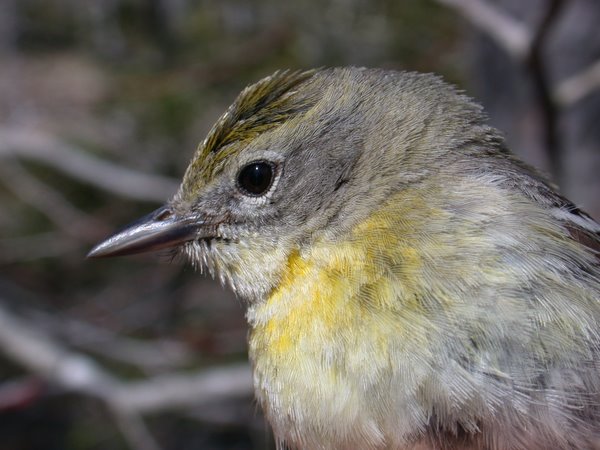
The Northern Parula arrived today, April 2d. Parulas, of course, breed in the Spanish Moss in the Park each spring/summer---with some banded birds returning on multiple springs to nest within the area in which we band. This first arrival was an unbanded, after-second-year male. Perhaps this bird spent the winter in The Bahamas. http://www.allaboutbirds.org/guide/northern_parula/id
These three arrivals signal that the migration is underway and gathering momentum. It will not be long before Gnatcatchers, Catbirds, Flycatchers and the later-arriving warblers visit First Landing once again. Come see them some morning.


Friday, April 6, 2007

A Winter Wren for a Winter-like, Spring Day.


Seventeen birds found our nets today and only a few looked comfortable as they were banded, measured, weighed and photographed. Species which rely upon insects for their primary food source, such as the female Northern Parula and male Blue-gray Gnatcatcher pictured, were fluffed up to save energy, perhaps concerned when they might find their next meal in this cold Canadian air. Such is the plight of the north-bound migrant with an early spring urge to forge north to their breeding grounds.

The Winter Wren, also, is a migrant! And they breed in Alaska, across Canada and the northern tier of the United States, nearly coast-to-coast! Why, with those short, rounded wings and that short, stubby tail, it seems a wonder that such a bird can fly across the street, much less across the mouth of the Chesapeake Bay and beyond. Indeed, this half-pint of a wren weighs several grams more than and has wings over one-half inch shorter than a Kinglet. Not bad for aerial maneuvers of short duration, but ……how do they ever make it there and back again? Compare the male Golden-crowned Kinglet caught today. Small, yes; but built to fly a few hundred miles in a reasonable amount of time.
All banders enjoy Winter Wrens. They are a challenge to catch, a horror to get out of the net (invariably they are captured in the lowest pocket of a net and often manage to twirl themselves into a ball of netting and bird) and a test to get out of a bird bag. You see, Winter Wrens think they are mice with wings. They can run as well as they can fly. They know there is only one way out of the bag and that the hole need not be very large for them to escape. They need not escape directly. They are content deftly to avoid your hand as the bag is being opened. In a moment they can wiggle up your sleeve and emerge from the neck of your tee shirt before taking flight. Ask my friends Betsy Brooks and Ryan Kayhart at Braddock Bay Bird Observatory near Rochester, NY, www.bbbo.org!
Finally, the male American Goldfinch pictured was also comfortable in the cool air gripping First Landing today. But if molting new body feathers is as itchy as it seems it ought to be, perhaps he was not entirely so. Within a week or three, this fellow will have his shiny black cap and bright yellow body feathers for the breeding season ahead. Winter is over, even if there are snow flurries and frost predicted overnight.
Peter

Tuesday, April 3, 2007

The Migration Heats Up.


Over the weekend and into the new week, the spring migration slowly gathered steam. The first Common Yellowthroat and Northern Parula were netted over the weekend. This morning, Parulas were singing along with Black and White Warblers, White-throated Sparrows, Winter Wrens AND Eastern Towhees, together with the usual suspects.
New groups of Song and Swamp Sparrows were banded along with three Yellow Palm Warblers, including the individual pictured above. Today's final tally was 22 new banded, 9 recaptures. There was one new species-an American Robin. Now we shall see what the cool weather forecast through the Easter weekend brings to First Landing.
Peter